
What a Greenwich Resident Lookup Covers
There is no single official Greenwich resident directory. A careful search is a sequence of record-specific queries, each with its own date and identity meaning. The Town Clerk land index, Assessor and GIS channels, Stamford-Norwalk court records, Probate District 54, voter tools, vital records, business filings, and local history collections answer different questions. A useful result is a source map with a name, date, record type, address role, and confidence, not a claim that one hit proves current residence.
| Record | What It Confirms | Where to Search | Access |
|---|---|---|---|
| Land record | Named parties, instrument, parcel or address clue | Greenwich Town Clerk land search | Online index and image; Town Clerk fallback |
| Assessor and GIS | Assessed parcel, owner field, map or abutter context | Assessor and GIS | Counter, phone, field-card and map requests |
| Voter registration | Registration or polling context as officially exposed | Connecticut MyVote and Greenwich registrars | Individual lookup; file has strict rules |
| Civil case | Party name, docket, case type, dates and disposition fields | Connecticut civil inquiry | Online index; courthouse for older or restricted material |
| Probate | Case number, type, status, district and fiduciary route | Probate District 54 lookup | Online data from 2011; vault and status rules |
| Vital record | Birth, death, marriage or civil-union event | Greenwich Town Clerk or Connecticut DPH | Eligible copy request; no open recent name index located |
| Business or license | Entity, trade name, credential or filing role | DCP eLicense and Secretary of the State | Online search plus filing and custodian routes |
Choose the first query from the clue in hand. A full name needs a date, address, parcel, docket, or role. An address can lead to land records, the Assessor, GIS, and permit files. A family question may call for Probate or vital records, while a historical question belongs with Library and archive sources before any current-record comparison.
Greenwich Resident Lookup Needs a Second Identifier
Common names, shared initials, entity names, former street names, and different address roles make name-only searches fragile. Greenwich has no Fairfield County recorder or county clerk to merge these sources. The Town Clerk is the local route for land records, while the Assessor provides counter binders, public terminals, phone inquiries of up to five at a time, field cards by email or mail for $1 per card, Grand List and street reports, and other files under its published process. The Assessor's public web parcel search was not located, so the counter and request routes should remain visible.
Use the narrowest official identifier first, then keep each role separate:
- A deed book and page, document number, Parcel ID, docket, application number, or exact address is stronger than a shared surname.
- A grantor, grantee, trustee, lender, fiduciary, agent, licensee, or registered agent is a record role, not proof of current residence.
- A Grand List or tax result may identify an assessed owner or account, while a directory may identify a householder, business, or phone entry from a past year.
- Preserve the source date and spelling before joining two records. If only a common name agrees, leave the records unjoined.
The Town Clerk land-record instructions point to Quick Search and Advanced Search. Advanced fields include Party Names, separate Grantor and Grantee, recorded and instrument date ranges, document type, document number, book, page, remarks, Property Address, and Document Image phrase. Try spelling variants and record the portal's certification-through date.
Greenwich Resident Lookup Court Party Fields
Greenwich is routed through the Stamford-Norwalk Judicial District, not a Fairfield County court office. The district includes Greenwich, Stamford, Norwalk, Darien, New Canaan, Weston, and Wilton. The Stamford courthouse is at 123 Hoyt Street, Stamford, and the State's Attorney directory lists 203-965-5215 for Part A and 203-965-5255 for GA1. The official civil inquiry portal is a case-index tool with party, docket, court-location, calendar, legal-notice, pending-sale, and property-address routes. No separate Greenwich municipal party-name portal was located.
The Connecticut civil inquiry portal shown in the manifest source is the correct starting menu for civil case research.
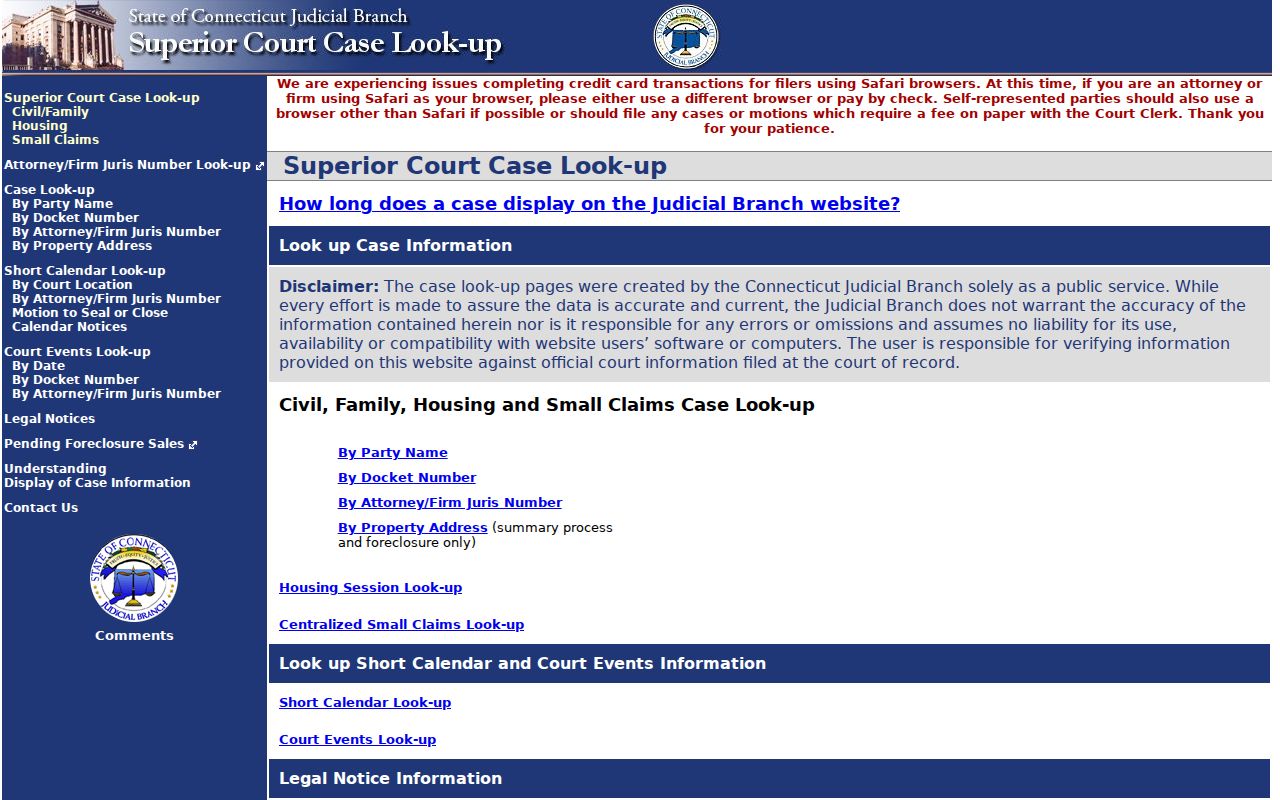
The menu separates party, docket, address, and court-location searches, which helps keep a one-person query tied to the right record type.
The exact party form requires a last name and accepts an optional first name, location, case category, case type, sort order, and a name-search mode. Apostrophes may need to be tested with and without. Scheduled events refresh nightly, while case information changes as it is entered. Protected parties may be omitted.
| Party Last Name | Required text field. |
|---|---|
| Party First Name | Optional text field. |
| Location | Dropdown for the court location or available location option. |
| Case Category and Type | Dropdowns that narrow the case route. |
| Name Search Type | Start With, Contains, Is Equal To, or Sounds Like. |
The party-search controls are visible on the official Stamford-Norwalk party search.
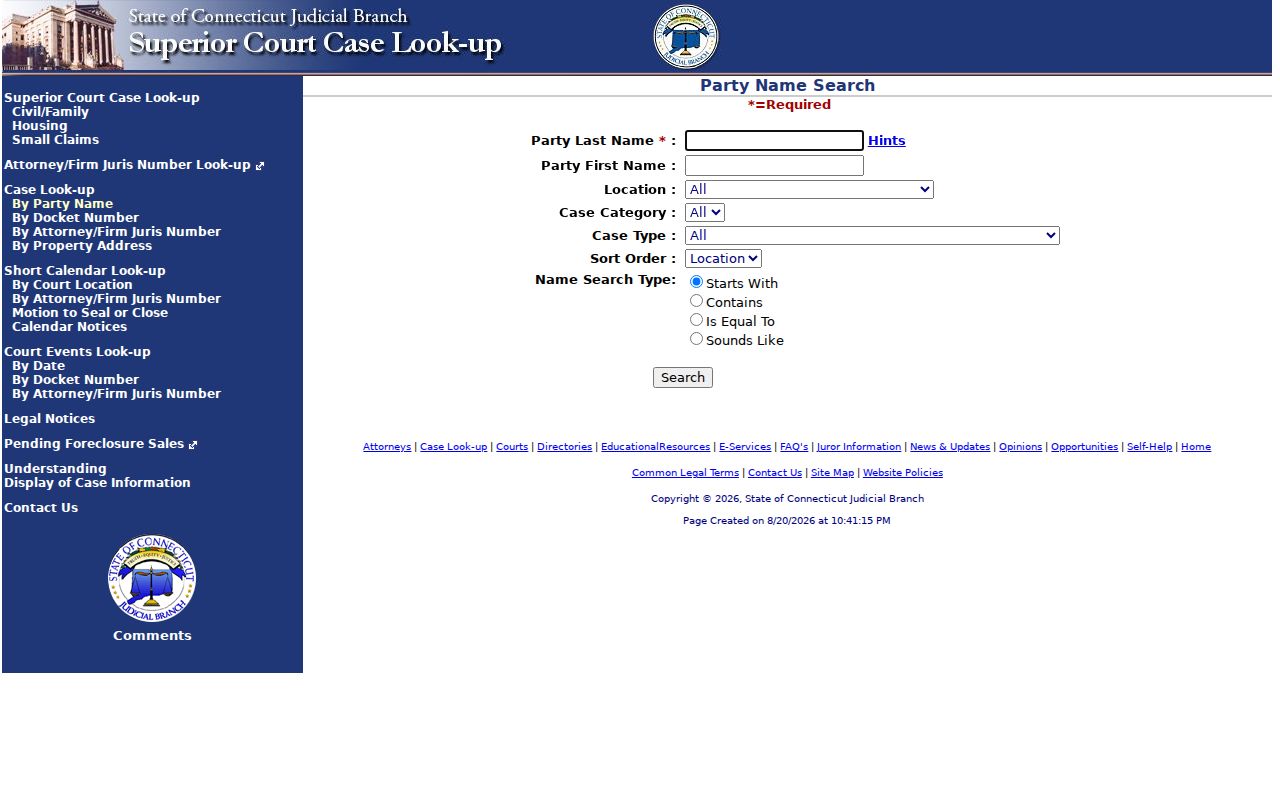
Use the required last name field with a location and name-search mode, then inspect the docket and party role before linking a result to a person.
Civil and related electronic documents generally cover return dates from January 1, 2014. Small-claims documents use a separate filing-date rule, with the research noting filings on or after October 16, 2017. Older civil material is available on courthouse public computers. Family documents are not generally public online. A municipal FOI request cannot compel a court to release a protected filing.
Verifying a Greenwich Resident's Records
A reliable Greenwich resident lookup uses two independent facts that agree on a name and a second identifier. The second identifier may be an address, parcel or document number, date, middle initial, business role, or docket. Keep the source date and describe the record role in plain terms. A court party may be a plaintiff, defendant, attorney, guardian, fiduciary, or self-represented person. A deed may name a lender or trustee. Those distinctions are part of verification.
- Anchor the name to an address or parcel through the Town Clerk land index, Assessor route, GIS request, or a legitimate voter lookup.
- Run the civil party search with the last name, first name, Stamford-Norwalk location, and more than one name-search mode when needed.
- Compare docket, file date, case type, party category, and last action. Do not join a result based on a name alone.
- Use the Town Clerk or DPH route for a vital record when the requester meets the record's eligibility rule, and keep an index separate from a copy.
- Write the conclusion with a date and role, such as “named in the recorded instrument” or “listed in the directory year,” rather than claiming current residence without support.
- Docket
- A court's case identifier. The docket ties the party, case type, dates, filings, and later actions together.
- Index versus image
- An index summarizes a record for searching. An image is the scanned or filed document and may have separate access rules.
- Certified copy
- A copy issued by the custodian with official certification. It is different from an online result or an uncertified reference copy.
A court result can show the fields below. The official display guide says the online lookup is not the official court record, so verify with the clerk before relying on a detail.
| Result field | What it shows |
|---|---|
| Case name and type | The indexed case title and category. |
| Docket number | The court identifier used to retrieve the case. |
| File, return, and last-action dates | Key dates displayed in the case record. |
| Disposition and judge or magistrate | The listed outcome and decision-maker fields when available. |
| Party or appearance | Name, jurisdiction number, category, number, and type. |
| Motions, pleadings, or documents | Entry number, description, filing party, file date, and result. |
| Scheduled event | Event, status, time, and related date information. |
Greenwich Resident Lookup Vital Record Rules
Greenwich Vital Statistics handles events filed in Greenwich, while the Connecticut Department of Public Health State Vital Records Office supplies statewide routes and eligibility guidance. The current Town page says a certified copy is $20 each and requires government photo ID for an in-person, mail, or online request. A mail request should include the required form, payment method, ID material, and a self-addressed stamped number-10 envelope. The page's online channel and any third-party charge should be checked at the time of request.
Birth records younger than 100 years have relationship and eligibility limits under CGS §7-51. Death certificates are generally available to people 18 and older, with Social Security number access restricted. Marriage certificates are generally available to adults, while Social Security numbers remain limited. Adoption and original-birth-copy rules are different: the Town describes an informational uncertified copy route for an adult adoptee or qualifying adult relative, while other requesters need a court order. Connecticut records from July 1, 1897 forward can be routed through town or state offices, and DPH says a state request can take up to 12 weeks. Before July 1, 1897, the town of event is the main route.
The Greenwich birth, death, and marriage certificate page is the manifest source for the current local fee, photo-ID rule, request routes, and adoption-copy note.
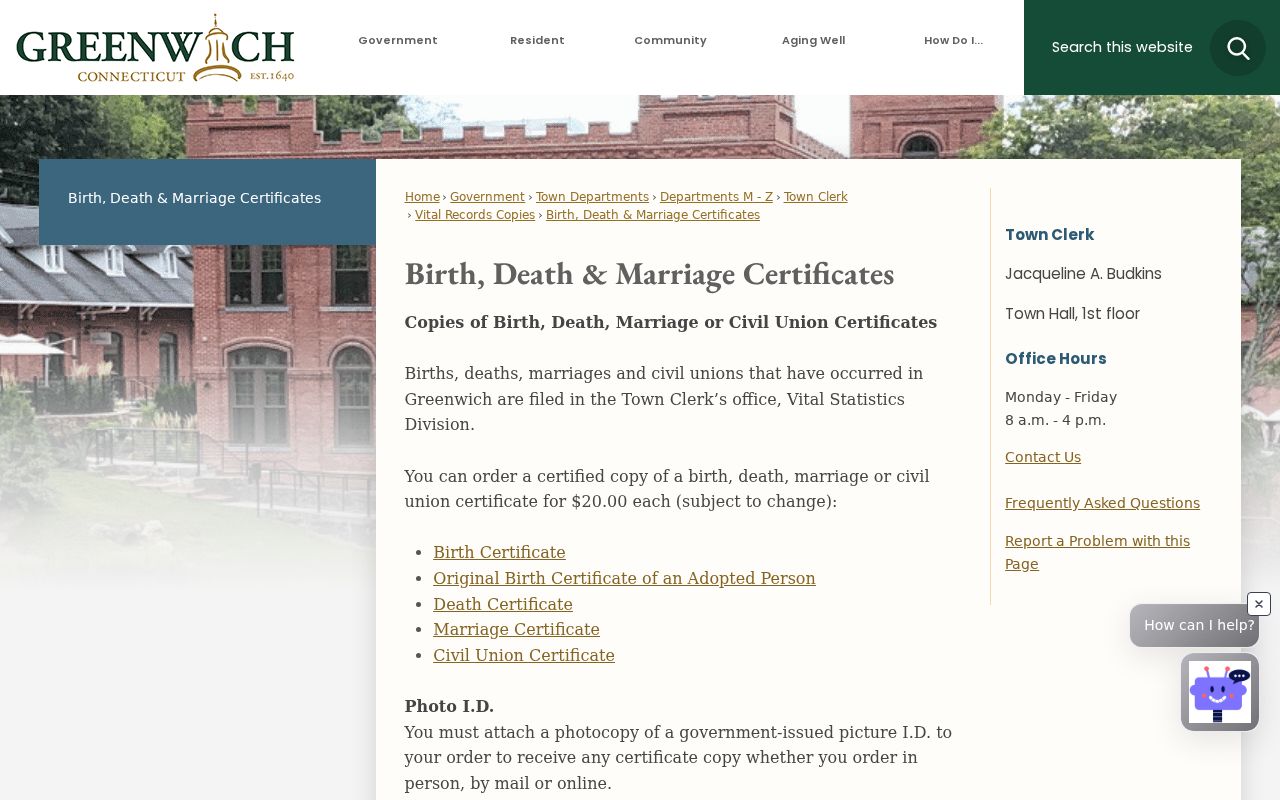
The Town page shows why a record type, requester relationship, and certification status must be identified before a vital-record request is sent.
No official public Greenwich name index for recent births, deaths, or marriages was located. The confirmed public route is a Town Clerk or DPH certificate request. Greenwich Library and the Connecticut State Library may add historical context, but they do not replace a certified copy.
Greenwich Resident Lookup and Voter Privacy
The official Connecticut voting page links to the MyVote individual lookup. It is the first route for a person checking registration or polling information, not a general contact list. The unattended research pass could not expose the public screen's exact result fields. The state Connverse manual is a registrar-side fallback that describes current or previous name and address searches, local or statewide scope, voter ID, DMV ID, last name, street name, optional first name and date of birth, and a no-match response. Do not assume every registrar control appears on the public screen.
Greenwich has two registrars at Town Hall, 101 Fieldpoint Road, with the published 203-622-7890 and 203-622-7889 numbers. Connecticut voter records can include registration applications and election participation, but the month and day of birth are exempt from public release under Public Act 26-1 §96, leaving only the birth year in the released field. A voter may also use the state privacy program when disclosure creates a safety concern.
The centralized voter file is a separate written route. The official request form describes a CSV, a $300 cost, and permitted election-related, scholarly, journalistic, political, or governmental uses. It bars personal or private use, advertising, solicitation, marketing, reproduction, distribution, and harassment. For a normal one-person query, use MyVote or the Greenwich registrars. FOI does not override voter privacy, birth-date, or protected-person rules, and the Library's historical election sources are context rather than registration proof.
Greenwich Resident Lookup State Status Limits
Greenwich does not publish a municipal jail roster in the official pages located. Police Records is the local report route, while the Connecticut Department of Correction and DESPP provide separate state systems. A Police Records request may be made online or by printed form mailed or hand-delivered to the Public Safety Complex. Routine requests are listed at 5-7 business days, and open investigations or protected material may be withheld. The Town's fee notes list 50 cents per page, $19.50 for CD or DVD, and $26 for a flash drive, with prepayment rules for larger estimates.
The Town's Crime Statistics page links a dashboard refreshed daily around 7:00 a.m. with prior-day data. The Town calls it preliminary and says precise locations may be generalized or withheld for active investigations and victim privacy. Use it for date, category, or geographic patterns, not to infer that a named person lives at a location or caused an event.
The Connecticut DOC Inmate Information service concerns current DOC custody, updates daily, and may omit youthful-offender and federal-immigration cases. The DESPP Sex Offender Registry displays statutory registry fields such as last-known address and physical descriptors, but DESPP says it has not assessed an individual's risk or determined that an included person is currently dangerous. Neither system establishes a Greenwich residence or replaces a court disposition.
Greenwich Resident Lookup Business and License Roles
A business hit can help identify a public affiliation, but it cannot be turned into a residence claim. Greenwich local business identity begins with a trade-name filing at the Town Clerk, not a county office. The Town's registration route lists the Clerk at 203-622-7897 and the Assessor at 203-622-7885 for personal-property declarations. The trade-name form has a $20 fee and fields for the trade name, purpose, address, filer, filing number, volume, page, and signatures. Treat the filer, owner, agent, business address, and property owner as separate roles.
The Connecticut Secretary of the State Business Search accepts a business name, ALEI, or filing number. Results can show entity name, principal, registered agent, formation date, entity type, address, and filing history. Records older than 15 years may not be online. The DCP eLicense License Lookup accepts license type, prefix, number, status, business or DBA, first and last name, and address fields. Results can show credential number, type, effective and expiration dates, scope, and supervisor. A license proves the credential record, not a current home or work location.
Use online search, Town Clerk filing and phone routes, Assessor declarations, DCP rosters, and FOI requests for non-exempt municipal files as appropriate. Preserve the filing or status date and state whether the address is a business, mailing, registered-agent, or parcel address.
The Connecticut eLicense lookup page is the manifest source for the credential fields described above.
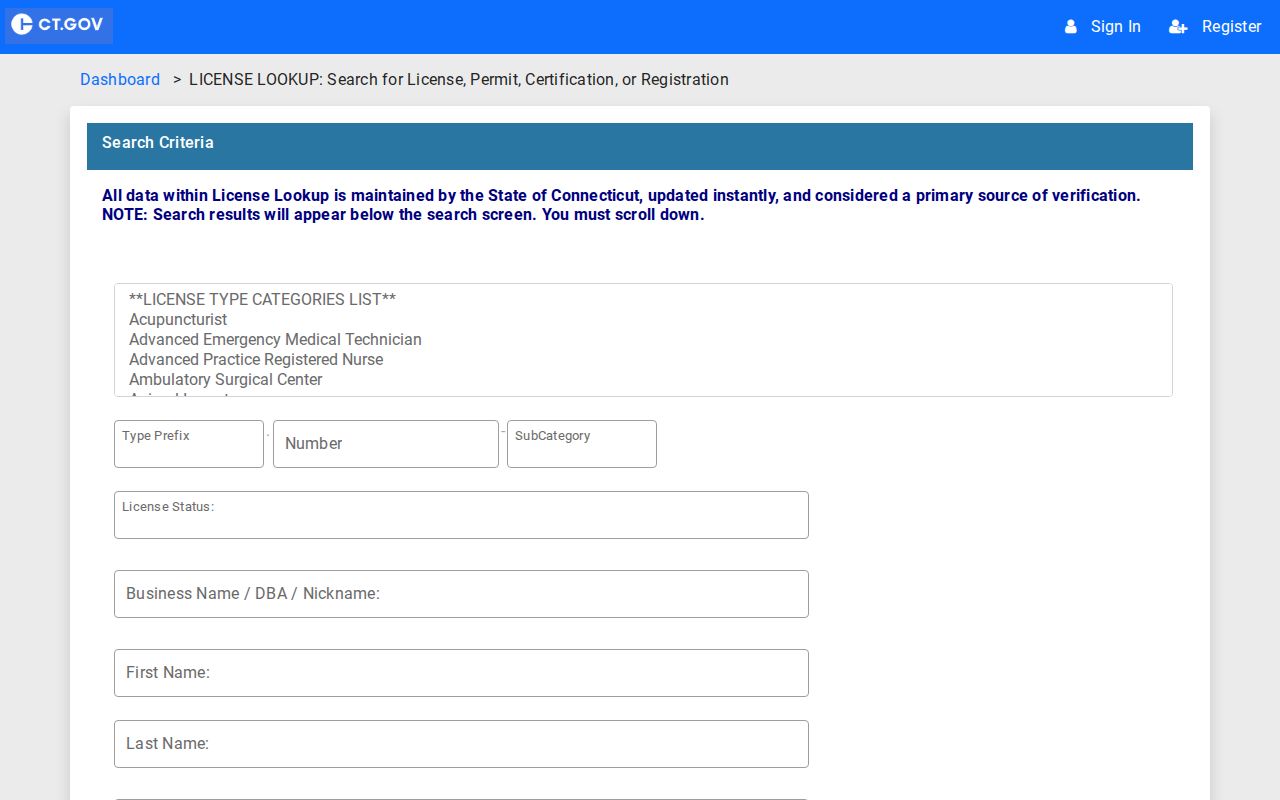
The result route is useful for confirming a license role and status, but it should not be stretched into a claim about where a person lives.
Greenwich Resident Lookup Historical Cross-Checks
Greenwich Library and the Historical Society are local research custodians, not current resident lists. Their value is time and context. Library directories connect names to a street and year; the Newspaper Index points to marriage, obituary, and local-interest articles; maps show villages, owners, roads, and changing geography; oral histories preserve memories; and Historical Society finding aids point to family papers, organizations, plot plans, and photographs. A dated historical line should be written as “listed in” or “recalled in,” not “lives at.”
For a probate or estate question, the Connecticut Probate lookup identifies cases from January 5, 2011 to the present, with Case Type, District, Status, First Name, and Last Name controls. Choose PD54 Greenwich. Results show case number, names, type, and district, while older records are incomplete and pending documents have interested-party or attorney rules.
The Greenwich Probate case lookup is the manifest source for the District 54 search route.
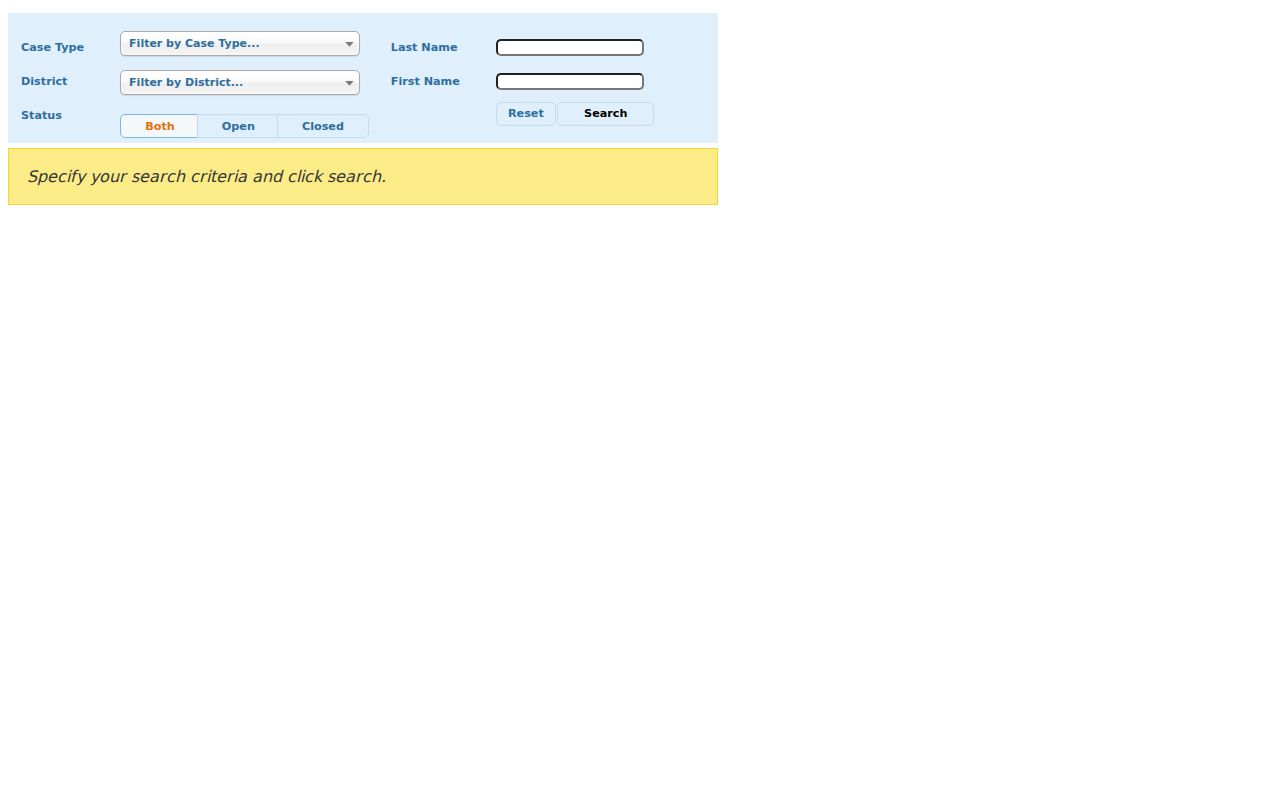
Probate metadata can point toward an estate or fiduciary record, but it does not by itself prove a person's residence or current role.
For the historical shelf itself, use the Greenwich city directory collections and then confirm a modern identity through the appropriate custodian. The source date and record role matter more than a name match alone.
Legal Limits on a Greenwich Resident Lookup
Connecticut's Data Privacy Act gives qualifying consumers access, correction, deletion, portability, and opt-out rights with respect to covered businesses, but government entities are exempt. A private-data deletion request does not erase a Greenwich deed, Grand List entry, court index, voter record, or vital record. The custodian's statute and retention rule control. If a result is wrong, bring the source date, document number, and correction request to the office that holds it.
Safety programs are record-specific. Connecticut's Address Confidentiality Program supplies a substitute address and legal-agent route for qualifying participants. The voter privacy program can limit registration disclosure through an affidavit. FOI §1-217 and law-enforcement exemptions can protect certain people, victims, witnesses, minors, active investigations, and identifying details. DPH rules limit birth, adoption, parentage, and Social Security information, while DMV identity data follows separate federal and state restrictions. Honor a substitute address and ask the custodian about a nondisclosure rule rather than trying to find the actual address.
Lawful use. A Greenwich resident lookup is for personal, lawful research. Do not use a public record to stalk, harass, intimidate, surveil, impersonate, or publish protected personal details about another person.
Connecticut stalking and harassment statutes, the FOI Act, voter-file form, vital-record rules, ACP, and police exemptions create separate boundaries. Request only the minimum record fields needed for a legitimate purpose, preserve the source date, and verify a disputed result with the custodian.