
Greenwich Past-Resident Sources by Era
Previous residents of a Greenwich address appear in different record families as the decades change. A deed is strongest for a legal transfer. A directory is strongest for a dated listing on a street. A map can show an owner label or a building footprint, while a census or newspaper index may add household or obituary context. Permit and environmental files show a project role. The custodian, date, and role should stay beside every name.
| Source | Years it covers | Where held | What it shows |
|---|---|---|---|
| Town Clerk land records | Indexed and scanned back to 1927 in current operations material; earlier books require confirmation | Greenwich public land-record search and Town Clerk vault | Grantor, grantee, instrument, date, book/page, legal description, and image when available |
| Greenwich Library directories | 1885-86 through 1934-35 in the named digitized series | ContentDM and Local History | Street guides, private citizens, householders, businesses, profiles, and phone cross-reference by year |
| Maps and atlases | 1869, 1889-90, 1893, 1931, 1975-77, and 1992 map sets | Greenwich Library map collection and local archives | Owner labels, roads, villages, school districts, parcel setting, and changing place names |
| Census and newspaper index | Period-specific; 1870-1929 is the key directory and household research era | Library microfilm, databases, hardcopy, and the Newspaper Index | Household clues, local events, marriages, and obituaries tied to a dated source |
| IWWA, building, and P&Z files | IWWA online set covers 1973-2014; later files move to offices or current portals | IWWA search, Building Inspections, P&Z, and permit record rooms | Owner, agent, contractor, applicant, project, street-number, or inspection roles |
| Probate District 54 | Current case metadata online; older or fuller files require the local court route | Connecticut Probate case lookup and Greenwich Probate Court | Case number, type, status, decedent, fiduciary, district, and filing-date context |
For a nineteenth-century question, begin with maps, deeds, probate, and local history. For the late nineteenth and early twentieth centuries, directories, census schedules, newspapers, and atlases can connect a street to a household clue. For a later project, use IWWA, P&Z, building, GIS, and deed material. The access chain includes online indexes, the Library counter or appointment, Historical Society staff, Town Clerk and Assessor counters, phone or mail requests, and a precise Connecticut FOI request when a non-exempt municipal record is not online.
A Greenwich Previous Resident Needs a Date
“Previous resident” is a convenient search phrase, not a field that every Greenwich record uses. A deed names a party to an instrument. An Assessor file lists a role on an October 1 Grand List or related file. A directory may list a householder, boarder, business, or phone subscriber. A probate record names a decedent or fiduciary in a case. A permit can name an owner, agent, contractor, or applicant. Those roles may overlap, but they should not be merged without a second source.
Write “listed in the 1930-31 directory” or “named as grantee in document number” instead of using a present-tense claim. The research standard for a person-address match is two independent official or archival facts that agree on a name plus a second identifier such as an address, parcel, date, document, middle initial, business role, or case number. If a source is historical, label it historical. A common name alone is not enough to identify previous residents.
Note: A dated source role is more precise than calling every owner, householder, business contact, or fiduciary a resident.
Greenwich House History for Past Residents
Greenwich Library's house-history method begins with deeds and a deed chart, then uses census schedules, directories, and maps as support. That order matters. An address can change its number or street name, while a legal description, instrument, or parcel relationship may remain the stronger bridge. Start with the Town Clerk's record, write down the book and page or document number, and keep the source date beside the name.
The Greenwich Library house-history route points researchers toward an Historic Home Occupant Chart and a Historic Home Deed Chart. If that particular guide moves, the Library's Local History and Genealogy service is the practical fallback. Staff can help locate a vertical file, map, directory, or microfilm item, but the final chart should cite the primary record rather than a staff summary alone.
Current parcel or address → recorded deed → named party and legal description → earlier instrument → dated directory or census clue → map, newspaper, or probate confirmation.
This chain can also expose a gap. If a current address does not appear in an older directory, search the historic street name, village label, lot or legal description, and map period before deciding that the address had no earlier record.
Trace Greenwich Previous Residents Through Deeds
Connecticut has no operating Fairfield County recorder or county clerk for Greenwich land instruments. The Greenwich Town Clerk is the local custodian. Begin with the Assessor's counter, field-card, Grand List, street-report, phone, email, or mail route when an owner or parcel clue is needed, then move to the Town Clerk's online land index. Record the portal's certification-through date and do not assume that an online cutoff means the land history ends there.
- Pull the current parcel, owner, transfer volume/page, and legal-description clues through the Greenwich Assessor route. The Town did not expose a public web parcel search in the research pass.
- Search the Town Clerk advanced index by property address, party, grantor, grantee, date, document type, book, page, or remarks.
- Open the purchase instrument and copy the document number, recorded date, party roles, legal description, property-address text, and linked image status.
- Take the seller named in that purchase as the next grantee to search. Repeat the same check backward, keeping every role and date in the chart.
- When a deed is outside the current online material, ask the Town Clerk about the vault, counter, mail, or other book and image access. Use FOI for a precise non-exempt municipal record, not as a substitute for a deed search.
- Grantor
- The party conveying an interest in the instrument.
- Grantee
- The party receiving the interest named in the instrument.
- Chain of title
- The sequence of recorded transfers that connects one interest to earlier interests.
- Legal description
- The deed's formal land description. It can remain useful when a street number or name changes.
- Enumeration district
- A census reporting area. It helps locate a historical household, but it is not the same as a modern parcel.
Greenwich Past Residents in Directories and Census
Greenwich Library's digitized directory series runs from the Turner, McClean & Losee's 1885-86 volume through Polk's 1934-35 volume, with Turner, Richmond, and Polk issues in between. The 1885-86 metadata describes a business index, street-by-street address guide, phone-number cross-reference, and household and business profiles. Polk's 1930-31 volume adds Cos Cob, Mianus, Glenville, Riverside, Sound Beach, East Port Chester, and Byram to its geographic description. These are dated regional guides, not current resident files.
Pair a directory year with a close census period, then compare the street guide, map, deed chart, and newspaper index. A useful sequence is directory alphabetical section, street or avenue guide, census schedule, map or atlas, Town Clerk instrument, and obituary or probate clue. The collection metadata and landing pages were inspected, but the unattended pass did not expose searchable OCR or a transcribed individual entry. Do not invent a sample name or page. The collections themselves are described on the Greenwich city directory page.
Names and phone details in an old directory should not be republished as current contact information. A household line may represent a householder, business, boarder, or address occupant for one publication year. Previous residents become meaningful when the role and date are kept visible.
Greenwich Previous Residents and Probate
Probate can close or clarify a house-history trail when a deed chart reaches an estate. Greenwich Probate District 54 is searchable through the Connecticut Probate case lookup. A result can supply case type, status, case number, decedent or fiduciary name, district, and date context. It does not by itself establish that a decedent lived at a particular street address or that a fiduciary still holds a role.
Use the online case clue to ask a narrower question of the Greenwich Probate Court. Older material, fuller files, and vault access may require the local court route. Pair a probate record with a deed, directory, obituary, or map and label the relationship. The record may explain an ownership transfer or family connection without revealing a complete household list.
The manifest capture of the Greenwich Probate Court and historical-record route places the local district beside the statewide case lookup.
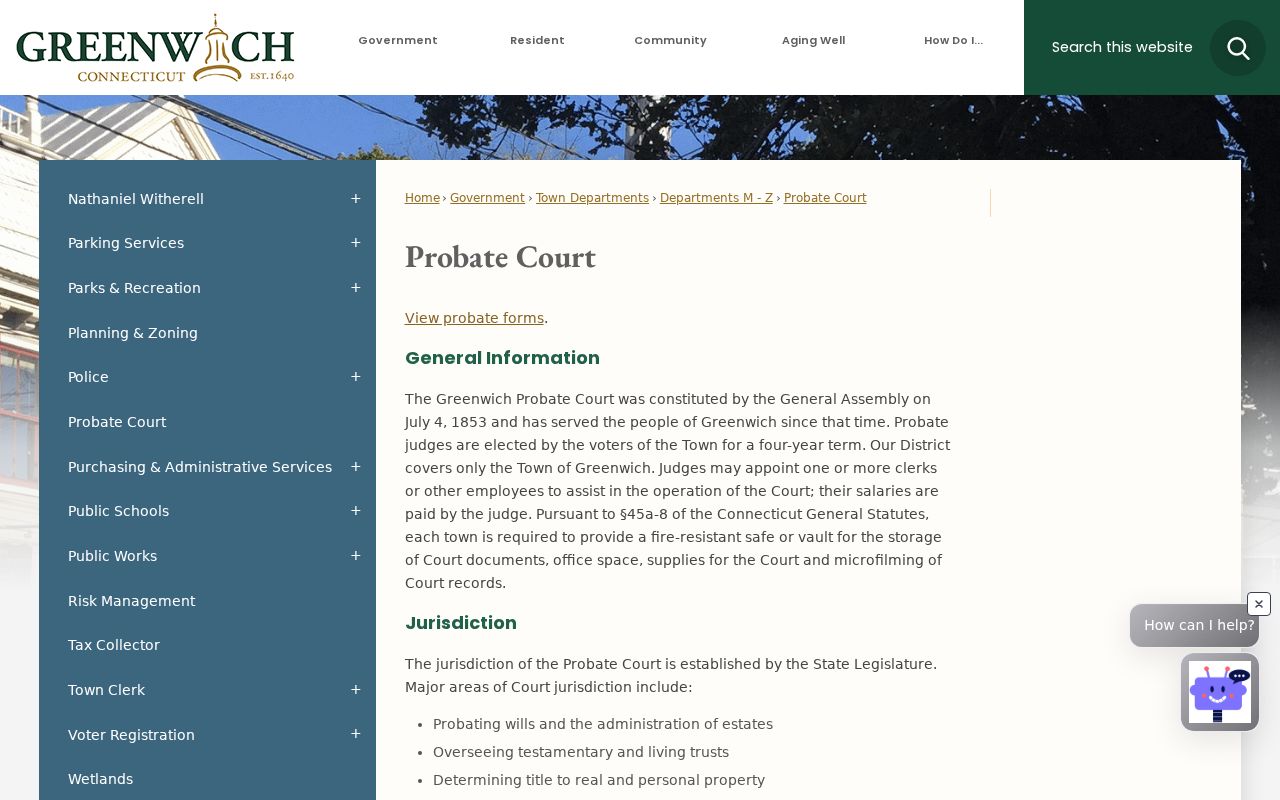
The court route is best used as a dated case lead, then checked against the instrument or archival source that connects the case to the address.
Greenwich Past-Resident Property Alerts
Greenwich's free Real Property Activity Alert adds a modern check to a backward deed search. The Town describes name or keyword alerts and document-based alerts that send an email when the public land-record portal receives a match. It gives examples such as a name appearing in a filing, a tax lien or release, or a possible fraudulent attempt. The alert is not a title guarantee, legal notice, or insurance product, and the portal disclaims guaranteed notice.
Use the alert as a prompt to open the actual instrument. Compare the document number, recording date, party roles, book/page, and linked image with the earlier deed chart. If a filing looks wrong, preserve the alert and document number, then contact the Town Clerk and other relevant professionals through independently verified official routes. A name match alone is not proof of fraud or a connection to a house.
The manifest capture of the Greenwich Property Alert setup shows the email-trigger route and its limits.
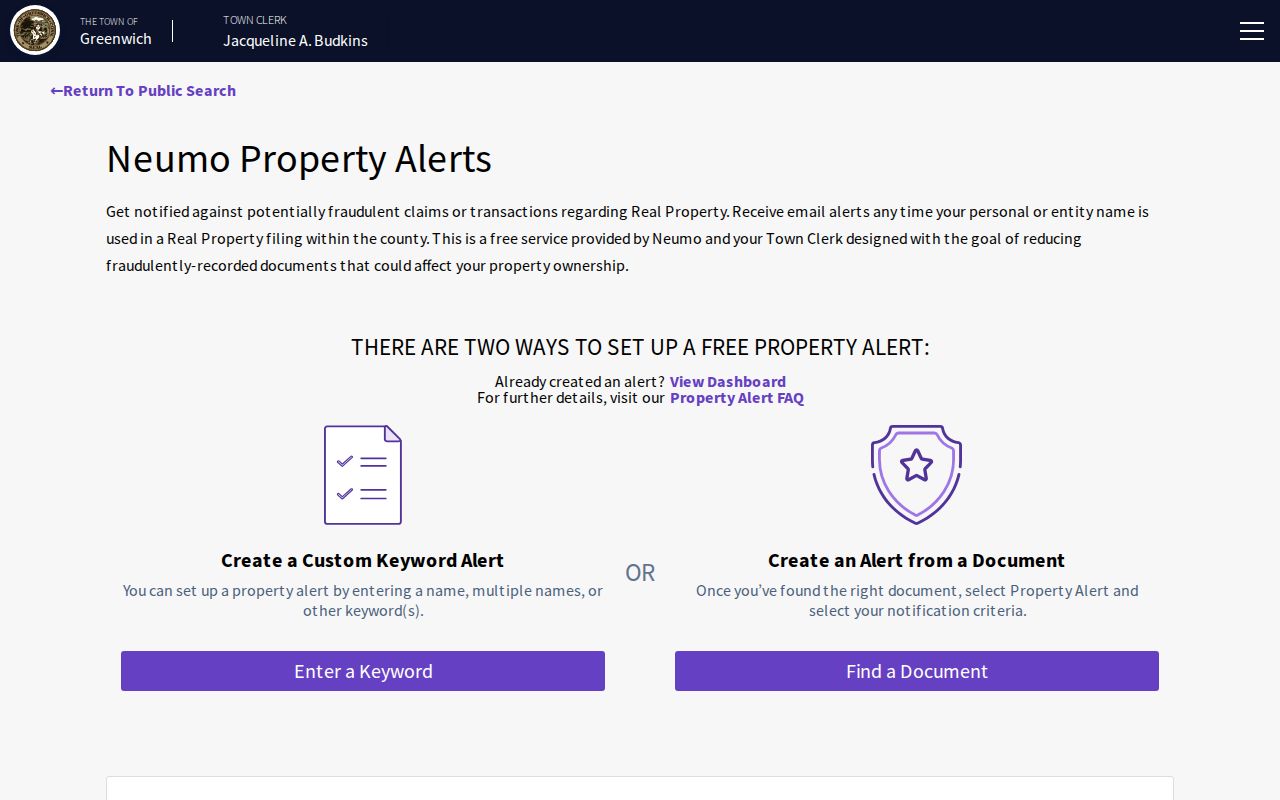
This timely tool belongs beside the deed chart, not in place of the instrument that proves what was recorded.
Greenwich Previous Residents in Maps and Memory
The 1869 Greenwich Town map names owners, villages, school districts, and roads. The later 1893 Town and City Atlas and 1931 Fairfield County atlas can help bridge an old road or village label to a deed chart. The Library's map list also identifies 1889-1890 topographic maps and later property maps. A map owner is a useful lead, but it is not necessarily an occupant or current owner. Give the map year and custodian in every note.
Sanborn fire-insurance sheets add a building layer. The Library of Congress Greenwich series includes February or March 1885, January 1891, September 1896, December 1901, and September 1906 items in the research inventory. Sanborn maps show structures, uses, and fire-insurance context, not people. Pair a building footprint with a deed, directory, or census schedule rather than treating the map as a resident record.
For local meaning, the Greenwich Historical Society Library and Archives holds manuscripts, genealogies, maps, photographs, and organization records related to Greenwich, Bush-Holley, and the Cos Cob art colony. Public access is on Thursdays during regular hours or by appointment. The Greenwich Oral History Project reports more than 1,250 interviews and 142 books, with memories reaching back to the 1890s. Oral history can explain a street name or neighborhood change, but it remains a recollection and needs attribution.
Greenwich Previous Residents Need Address Continuity
Address history can fail when a researcher assumes that a current street, village, and ZIP existed in the same form in every period. Greenwich records use Old Greenwich, Cos Cob, Mianus, Riverside, Glenville, Byram, and other local labels as geographic context. The legal town remains Greenwich even when a directory or map uses a community name. The current delivery ZIPs are 06807, 06830, 06831, 06870, and 06878, while 06836 is a Town Hall or PO Box special case rather than a sixth residential ZIP.
When an old line does not match, search the current and historic street name, a shortened road type, the village name, and the period map. Keep the exact address string, ZIP, parcel or legal description, directory year, and source date. A former road name can coexist with a new one after a P&Z and municipal street-name process. The lack of a current-format hit is a signal to normalize the address, not proof that earlier Greenwich previous residents were absent.
Note: A historical place label can explain an address without becoming proof of a modern postal city, parcel, or household.
Use Greenwich Previous Residents With Care
Household clues can come from Greenwich Library's Newspaper Index, which points to local-interest articles, marriages, and obituaries in Greenwich Time, Greenwich News, Greenwich Graphic, Greenwich News and Graphic, and Greenwich Observer. Referenced articles are available through hardcopy or microfilm. Probate, cemetery, directories, oral histories, and maps can add context, but each one has a different date and level of proof. Previous residents should be described as listed, recorded, interviewed, or connected to a source, not as current occupants.
Before sharing a name or address, check Connecticut privacy rules. The Address Confidentiality Program and voter privacy process can protect qualifying people, while FOI exemptions, vital-record eligibility, law-enforcement limits, and source restrictions can change what is available. Preserve a substitute address and do not attempt to discover an actual protected location. A house-history project is strongest when it explains what the record says and leaves unsupported present-day claims out.
Lawful use. Greenwich previous-resident research is for house history, family history, genealogy, and personal curiosity. Do not use a historical name or address to track, harass, intimidate, or expose a living person.